
Questions?
(800) 748-5647
(800) 748-5647
(800) 748-5647
(800) 748-5647
Table of Contents
Mudmats are interlocking ground stabilization panels placed in high-traffic or chronically wet areas of a horse paddock. Unlike solid rubber mats or temporary wood chip fill, interlocking plastic mudmats create a firm, permeable surface that water drains through rather than pools on top of.
The core problem they solve is focused: in a typical paddock, mud doesn't form everywhere at once. It forms in predictable locations where horses congregate repeatedly. Targeting those zones with mudmats is the most cost-effective mud management strategy available.
Before placing mudmats, walk your property and identify the zones where mud develops first and deepest. These are almost always the same across different properties:
Addressing each high-traffic zone with appropriately sized mudmat coverage produces the most visible improvement per dollar spent. Here's how to approach each zone:
Gate areas deserve the largest mudmat footprint. The approach zone on both sides of the gate, as well as a few feet in either direction along the fence, should all be covered. A mudmat apron of 10×14 ft to 12×16 ft is typical for a standard paddock gate.
The mudmat should extend at least 4–5 ft in all directions from the trough. This covers the natural zone where horses stand while drinking and captures overflow radius. A coverage of roughly 8×8 to 10×10 ft works well for most troughs.
Hay feeders and bale sites need coverage extending 6–8 ft in the direction horses approach from. If the feeder is positioned against a fence, only the open side needs coverage. Round feeder surrounds work well with a 12 ft diameter coverage circle.
Cover the full width of the run-in shelter entrance plus at least 8–10 ft out from the drip line. This ensures horses standing in the shelter doorway are on solid footing even during heavy rain.
Standard gate area — 10 ft × 12 ft (120 sq ft)
~45 MCG-50 panels needed
Large double gate — 12 ft × 16 ft (192 sq ft)
~72 MCG-50 panels needed
Water trough surround — 8 ft × 10 ft (80 sq ft)
~30 MCG-50 panels needed
Hay feeder zone — 10 ft × 12 ft (120 sq ft)
~45 MCG-50 panels needed
Run-in shelter entrance — 12 ft × 14 ft (168 sq ft)
~63 MCG-50 panels needed
Fence-line path (per 20 ft) — 4 ft × 20 ft (80 sq ft)
~30 MCG-50 panels needed
Minimum order is 60 units (161 sq ft). Most single-zone projects are covered in one order; multi-zone projects may qualify for volume pricing over $10,000.

The MCG-50 by Hahn Plastics is the primary mudmat solution for horse paddock high-traffic zones. Each 19.69" × 19.69" × 2.12" panel covers 2.69 sq ft and supports 11,200 lbs per square foot. No substructure required. Fully relocatable. Free shipping. Minimum order 60 units.

The MCG-50's open-cell structure is fully permeable. Water passes straight through rather than pooling, keeping gate areas and trough surrounds dry even after heavy rain. The surface also provides reliable grip for horses moving quickly through gates at turnout and feeding time.
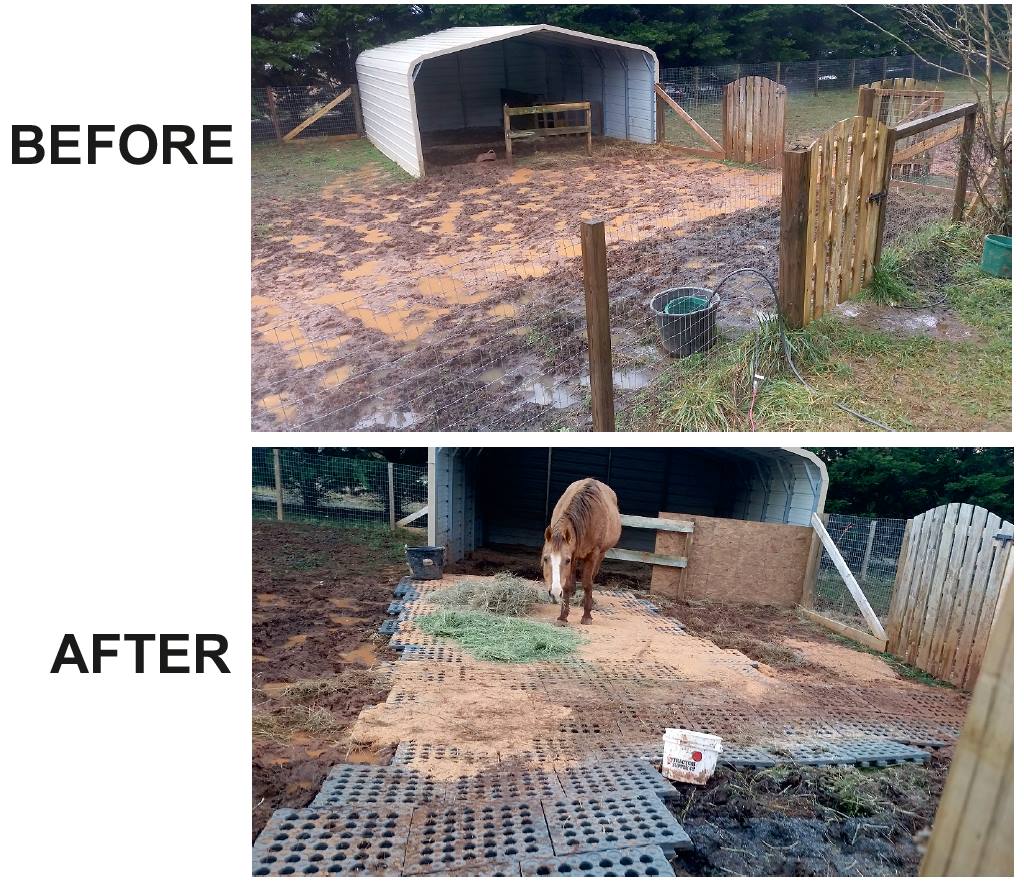
The modular interlocking design means you can start with a single gate zone and expand the mudmat coverage to additional zones at any time — new panels connect directly to existing ones without any modifications or adapters.

The PS-50-40-4 Paddock Slab is a lower-profile alternative at 1.58" depth with a defined 2.75" × 2.75" cell size. It's fully permeable and designed for daily equine and vehicle use. A practical choice when the lower step-height profile is preferred for barn or shelter entrances where horses may back over edges.
Both the MCG-50 and Paddock Slab ship free on qualifying orders:
Mudmats are interlocking plastic ground panels placed in high-traffic or chronically wet areas of a horse paddock to create a stable, permeable surface. They prevent horses from sinking into mud at concentrated-use zones like gates, water troughs, and feeding stations.
The highest-impact placement zones are gate areas, water trough surrounds, feeding stations, and run-in shed entrances. These are the zones with the highest hoof traffic density and therefore the fastest mud development.
A typical 10×12 ft gate area requires about 45 MCG-50 panels (2.69 sq ft each). The minimum order is 60 units, so you will have surplus for a second zone such as a water trough area.
No. Stall mats are solid rubber panels designed for indoor, hard-surface stall floors. Mudmats are interlocking plastic grids designed for outdoor use on soft, wet ground. The key difference is drainage: mudmats allow water to pass through freely, while stall mats are impermeable.
Yes. The MCG-50 and Paddock Slab are manufactured from HDPE plastic, which is UV-stable, frost-resistant, and unaffected by the freeze-thaw cycles that damage rubber and wood products. They perform reliably in all seasons and climates.
No anchoring is required for the MCG-50. The interlocking panel system holds itself in place under load. Edge panels along fence lines or building walls stay naturally confined. In extreme conditions, optional perimeter stakes can be used, but the vast majority of installations need no anchoring.