
Questions?
(800) 748-5647
(800) 748-5647
(800) 748-5647
(800) 748-5647
Paramount Materials — Ground Stabilization
Cell-Tek geocell — a cellular confinement system that locks soil and aggregate in place on slopes, shorelines, and driveways. Grid, accessories, and install tools, all in one place.
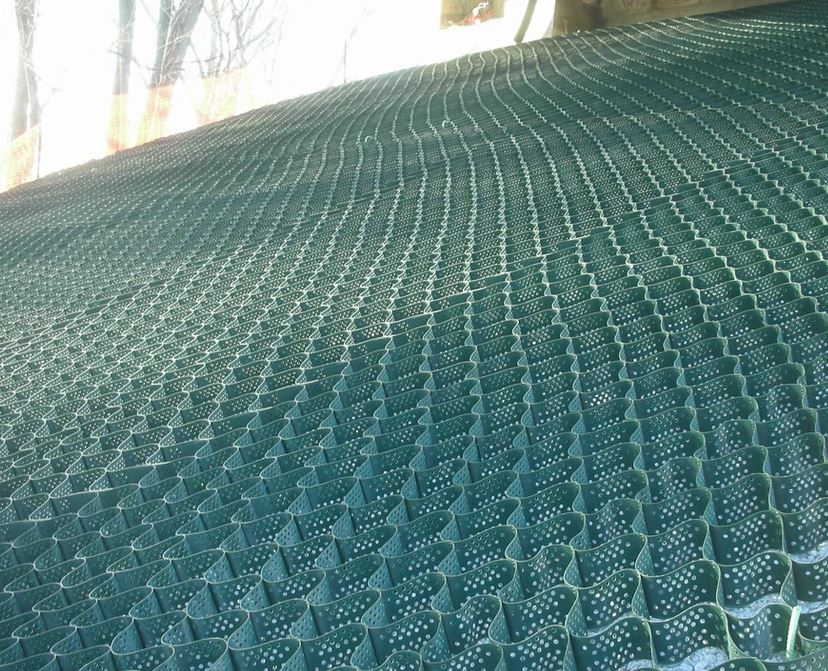
What it is
A geocell is a honeycomb of welded polymer strips that expands into a grid of cells. Fill those cells with soil, aggregate, or vegetated topsoil and the walls confine the fill — turning loose material into a stable, interlocked layer that resists sliding and washout.
That confinement is what makes geocell so effective for slope protection, shoreline and channel erosion control, and load support under driveways and pads. Cell-Tek offers two families that look almost identical but do different jobs: the larger-cell Slope Grid for erosion control, and the smaller-cell Load Support Grid (LSG) for driveways and load-bearing areas.
Load Support Grid
Smaller aperture cells that act as a load-bearing structural base. The tighter the cell, the greater the load support — so LSG is the choice anywhere traffic runs over the surface.
Slope Grid (SLP)
Larger aperture cells for areas that hold soil and vegetation but don't carry traffic. It performs the same confinement job for erosion control at a lower cost per square foot.
Rule of thumb: if anyone drives or parks on it, use LSG. For slope and erosion projects that won't see regular traffic, Slope Grid does the same job for less. Leftover LSG can always be used on a slope — a smaller cell never hurts, it just costs more than you need.
Smaller cell = more load support
Geocells are strips of material welded into walls. By confining aggregate inside those walls, the fill itself becomes far stronger and more stable. The smaller the cell, the greater the load support — because the confined mass is stronger when the space is tighter. That's why load-bearing surfaces use the smaller LSG cell.
Larger cell = lower cost
Slope protection and erosion control aren't load-support applications — nobody routinely walks or drives on them. Without that traffic, you don't need a smaller cell, so a larger cell works just fine. Larger cells use less material per square foot (like swiss cheese — more holes, less cheese), which makes Slope Grid a lower-cost choice for those jobs.
Holds soil and vegetation on graded hillsides and embankments against sliding and rain scour.
Armors banks, shorelines, and drainage channels where flowing water would otherwise erode fines.
LSG confines gravel into a firm, rut-resistant base for driveways, parking pads, and lots.
Stabilizes soft ground under access roads and working areas that carry vehicle loads.
Common questions
A geocell (also called a cellular confinement system) is a three-dimensional honeycomb of welded polymer strips that expands into a grid of cells. Filled with soil or aggregate, the cell walls confine the fill so it resists movement — creating a stable layer for slope protection, erosion control, and load support.
Cell-Tek geocell is made of durable polymer strips ultrasonically welded together into panels. The strips form the cell walls that confine and strengthen the fill material once the panel is expanded and anchored in place.
The difference is cell size. LSG has a smaller cell (8.8" × 10.2") for load-bearing surfaces like driveways and parking pads, where a tighter cell gives more load support. Slope Grid has a larger cell (10.7" × 12.4") for slope and erosion projects that don't carry traffic, and costs less per square foot because it uses less material.
Use LSG. A driveway is a load-support application, so you want the smaller LSG cell for maximum strength under vehicle traffic. Slope Grid's larger cell is meant for erosion control, not load-bearing areas.
Yes — that's exactly what Slope Grid is for. On slopes that won't see regular foot or vehicle traffic, the larger-cell Slope Grid confines soil and vegetation for erosion control at a lower cost. If you have leftover LSG, that works on a slope too; it just costs more than necessary.
Slopes beyond about 45° (roughly a 1:1 grade) are a special case — they need a tailored anchoring and reinforcement plan rather than a standard geocell-over-fill install, and factors like soil type, water flow, and slope height all come into play. For grades that steep, contact us for a custom quote and we'll help spec the right system.
Typical installs use anchors and tendons to hold panels in place (J-hook rebar anchors, earth anchors, and tendon cable with clips), plus a stapler and staples to connect panels together. A geotextile fabric underlayment is often added beneath the geocell. All of these are stocked above.
Match the right grid to your job — LSG for load, Slope Grid for erosion — then size your order. Pricing for most jobs is listed right on the site; need a volume quote? Request one below.
Slope steeper than 45°? Steep slopes need a tailored anchoring and reinforcement approach — contact us for a custom quote and we'll spec the right system for your grade.