Questions?
(800) 748-5647
(800) 748-5647
(800) 748-5647
(800) 748-5647
Everything contractors, engineers, and project managers need to know about turbidity curtains — from material selection to DOT compliance.
Table of Contents
When construction activity occurs near a body of water, disturbed soil and sediment do not stay on land. Rainfall, runoff, and equipment movement carry fine particles directly into nearby waterways — clouding the water, smothering aquatic habitat, and triggering regulatory penalties for the contractor. A turbidity curtain is the purpose-built solution: a floating barrier that contains suspended sediment within the construction zone and lets it settle out before it reaches open water.
This guide covers everything you need to know about turbidity curtains — what they are, how they work, which type is right for your site conditions, how to install and maintain them, and what the law requires. It is written for contractors, engineers, environmental managers, and project owners working on waterway construction, dredging, bridge work, shoreline restoration, and related projects.
A turbidity curtain — also called a silt curtain, turbidity barrier, or silt containment curtain — is a marine-grade floating barrier designed to contain turbid (sediment-laden) water within a defined zone during construction or excavation near a body of water. The term "turbidity" refers to water that has become murky or cloudy due to suspended particles of silt, clay, and fine soil.
While all water naturally contains some suspended material, construction activities dramatically increase sediment loads in adjacent waterways. Dredging, pile driving, excavation, and grading near rivers, lakes, bays, and ports can increase sediment concentrations to levels that are toxic to fish, harmful to vegetation, and illegal under federal and state environmental regulations.
A properly installed turbidity curtain creates a physical boundary between the disturbed zone and the open water body, allowing sediment to settle out in the enclosed area rather than dispersing downstream.
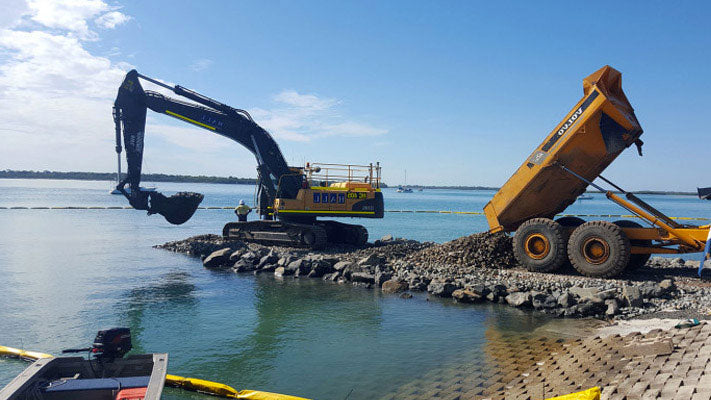
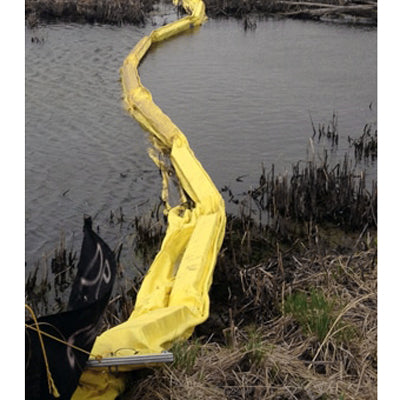
A turbidity curtain deployed along a construction shoreline to contain sediment during waterway work.
A turbidity curtain has three functional components that work together to contain suspended sediment:
Turbidity curtains are installed in sections — typically 50 feet long — that are connected to form runs of any required length. They are anchored in place using stakes, concrete blocks, or anchor kits depending on site conditions and current velocity. In Type 3 curtains, a portion of the skirt uses a permeable geotextile fabric instead of solid vinyl — this lets some water pass through to reduce pressure on the curtain in stronger currents, while still retaining sediment.
Type 1 turbidity curtains are designed for protected, calm water conditions. They are the appropriate choice when the installation site experiences no wave action and current velocities are minimal. Typical applications include ponds, small lakes, canals, and other still-water environments where the curtain will not be subjected to significant hydraulic stress.
Type 1 curtains use a standard vinyl-polyester laminated fabric with a flotation boom and galvanized chain ballast. Sections are connected with rope lacing or nylon ties and anchored with stakes or concrete blocks.
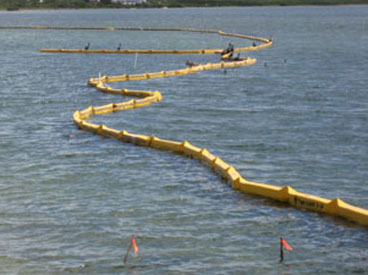
Best for: Ponds, small lakes, canals, marshes, calm water with no waves or tidal movement
Available depths: 3', 4', 5', 6', 7', 8', 9', 10' (custom depths available)
Section length: 50 feet standard (custom up to 100 feet)
The Type 1 DOT is the most widely used turbidity curtain for standard construction projects in calm water. The 5' x 50' size is a stocked item and typically ships within one business day.
Shop Type 1 Turbidity Curtains →Type 2 turbidity curtains are built for more demanding conditions than Type 1. They are designed to handle water bodies where current velocities reach up to 1.5 knots (approximately 2.5 feet per second in standard movement, up to 5 feet per second in some applications) and wave heights up to three feet. This makes them the standard specification for rivers, harbors, ports, and inter-coastal waterways with moderate current and tidal activity.
Type 2 curtains feature a heavier 18 oz. vinyl-polyester laminated fabric, an added top load cable (5/16 inch galvanized steel, 9,800 lb. break strength), and aluminum stress plates at cable termination points. These reinforcements distribute the load imposed by current and wave action, preventing curtain distortion and failure under moderate hydraulic stress.
Type 2 DOT curtains are commonly specified for demolition work, dredging, pile driving, bridge construction, and other activities near active waterways. When site conditions involve currents at the upper end of the Type 2 range, it is recommended to involve a qualified engineer in the anchorage and installation design.
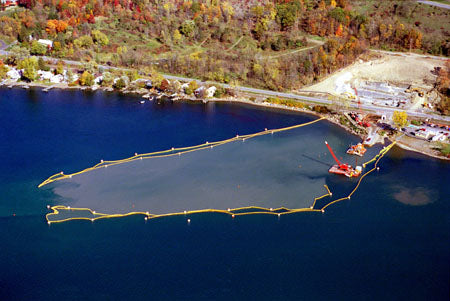
Best for: Rivers, harbors, ports, inter-coastal waterways with currents up to 1.5 knots, waves to 3'
Available depths: 3', 4', 5', 6', 7', 8', 9', 10' (custom depths available)
Key feature: Top load cable + aluminum stress plates for current resistance
The Type 2 DOT is the workhorse of the turbidity curtain product line, suitable for the majority of active waterway construction projects.
Shop Type 2 Turbidity Curtains →Type 3 turbidity curtains are the most robust option in the DOT classification system. They are used when construction activities occur near rivers, bays, harbors, or inter-coastal waterways with strong currents, significant tidal influence, or demanding hydraulic conditions that exceed the capacity of Type 2 curtains.
Type 3 curtains incorporate approximately 20% polypropylene filter fabric integrated into the skirt. This permeable section reduces hydraulic pressure on the curtain by allowing some water flow while retaining silt and sediment particles. The filter fabric is woven to the precise specification required to retain particles without becoming blocked, which would increase pressure and risk curtain failure. All seams are heat-sealed for maximum strength.
Type 3 curtains are required by some state DOT specifications for heavy-duty applications and are the standard choice for major infrastructure projects near active navigation channels.

Best for: Rivers, bays, harbors, inter-coastal waterways with demanding current and tidal conditions
Available depths: 3', 4', 5', 6', 7', 8', 9', 10' (custom depths available)
Key feature: 20% polypropylene filter fabric panel reduces hydraulic pressure while retaining sediment
Shop Type 3 Turbidity Curtains →Type 1 DOT — Calm, protected water
Current: Minimal / still Waves: None Applications: Ponds, small lakes, canals, marshes
Type 2 DOT — Moderate conditions
Current: Up to 1.5 knots / 5 fps Waves: Up to 3 feet Applications: Rivers, harbors, ports, tidal areas
Type 3 DOT — Heavy-duty / high current
Current: High current / tidal Waves: Significant Applications: Active navigation channels, bays, inter-coastal
Turbidity curtains are required on any construction project near a body of water where conventional land-based erosion controls cannot adequately contain sediment before it reaches the waterway. Common construction activities that require turbidity curtains include:

Construction activity without proper sediment control results in turbid water, which harms aquatic ecosystems and triggers regulatory violations.
Turbidity curtains are not just best practice — they are frequently required by law. Contractors working near water bodies must comply with multiple overlapping regulatory frameworks.
The Clean Water Act is the primary federal law governing water quality in the United States. It prohibits the discharge of pollutants — including sediment — into navigable waters without authorization. Violations carry significant fines and can result in project shutdowns.
Established under the CWA, the NPDES permit system governs stormwater discharges from construction sites. Projects that disturb one or more acres of land typically require a NPDES permit, which includes requirements for Best Management Practices (BMPs) — including turbidity curtains — to control sediment discharge into waterways. All Type 1, Type 2, and Type 3 DOT curtains available from Paramount Materials meet or exceed NPDES Phase II requirements.
Each state Department of Transportation has its own terminology and specifications for turbidity curtains on state-funded or state-permitted projects. While most states use the Type 1/2/3 classification system, some use different naming conventions:
| State | Terminology Used |
|---|---|
| Connecticut | Flat Water, Lightweight, Middleweight, Heavyweight |
| Florida | Floating Turbidity Barrier |
| Iowa / North Dakota | Floating Silt Curtain — Still Water / Moving Water |
| Minnesota | Floating Silt Curtain / Silt Barrier |
| South Carolina | Floating Turbidity Barrier — Light, Medium, Heavy Duty |
| Nebraska / New Jersey / Mississippi | Turbidity Barrier / Floating Turbidity Barrier |
Always consult your state's current DOT specifications before specifying a turbidity curtain on a public works project. Spec requirements differ in fabric weight, load cable specifications, and connection methods.

Diagram showing turbidity curtain components: flotation boom, impermeable skirt, and ballast chain.
Turbidity curtain installation varies by project, but the general process follows the same sequence for most sites:
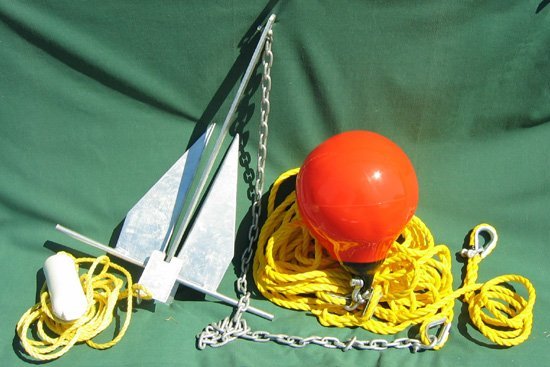
Anchor kits come pre-assembled from the factory with everything required: anchor, chain, rope, thimbles, anchor buoy, and shackles. Two kit sizes are available:
Kits attach to the cable loop at the barrier joint using the positioning buoy for easy repositioning or removal during the project.
Shop Anchor Kits →A turbidity curtain requires ongoing inspection to remain effective throughout a project. Once deployed, the curtain is subject to current, UV radiation, marine growth, floating debris, and mechanical stress from anchoring systems.
Inspection frequency depends on site conditions:
Each inspection should check the following:
Regular inspection catches damage before it leads to curtain failure and sediment escape. Curtains in high-stress environments require daily checks.
Answer three simple questions about your site conditions and our Turbidity Curtain Selector will identify the correct curtain type and depth for your project.
Use the Turbidity Curtain Selector →The selector tool guides you through water conditions (calm, moderate, or heavy-duty), current velocity, and required curtain depth. It returns a specific product recommendation with a direct link to purchase — eliminating guesswork and the risk of ordering a curtain that does not meet site requirements or regulatory specifications.
Paramount Materials sells only Tough Guy brand commercial-grade turbidity curtains — made in the USA and compliant with all known federal and state DOT specifications including NPDES Phase II. Free shipping on all orders.
Shop Turbidity Curtains →A turbidity curtain is a floating sediment barrier used at construction sites near bodies of water. It consists of a flotation boom at the top, an impermeable fabric skirt that extends below the water surface, and a weighted chain at the bottom to keep the curtain vertical. Turbidity curtains contain suspended sediment and silt within a defined area, preventing it from spreading into surrounding waterways.
Type 1 turbidity curtains are designed for calm water with no waves or currents — suitable for ponds, small lakes, and canals. Type 2 curtains handle moderate conditions with currents up to 1.5 knots and waves up to three feet, used in rivers, harbors, and ports. Type 3 curtains are the heaviest-duty option for demanding conditions near rivers, bays, harbors, and inter-coastal waterways.
A turbidity curtain should extend from the water surface to the bottom of the water body, with the bottom chain ballast maintaining contact with the substrate to prevent sediment from passing underneath. Available depths range from 3 feet to 10 feet in standard configurations, with custom depths available up to 100 feet. The correct depth depends on water depth at the installation site.
Construction projects near water are subject to the Clean Water Act and National Pollutant Discharge Elimination System (NPDES) requirements, which typically require the use of sediment controls including turbidity curtains. Many state DOT specifications mandate specific turbidity curtain types for waterway construction. Always check your state and local requirements before beginning any waterway construction project.
Installation time varies by project scale and site conditions. The main steps include laying out and connecting 50-foot sections on dry land, towing the assembled curtain to its final position, and anchoring. A crew experienced with turbidity curtains can typically install a standard 100–200 foot run in a few hours under calm conditions. Complex installations with high currents or difficult site access take longer and may require engineering guidance.
A silt fence is a land-based erosion control barrier installed along the perimeter of a construction site to intercept sheet flow runoff. A turbidity curtain is a water-based floating barrier deployed in bodies of water to contain suspended sediment. Both are sediment control methods, but they are used in different environments. Some projects require both — a silt fence on land and a turbidity curtain in the adjacent water body.
Browse the full selection of Type 1, Type 2, and Type 3 DOT turbidity curtains at Paramount Materials. All Tough Guy curtains meet or exceed federal and state specifications. Free shipping nationwide.
Shop All Turbidity Curtains →