Questions?
(800) 748-5647
(800) 748-5647
(800) 748-5647
(800) 748-5647
A practical guide for contractors and project managers on regulatory requirements, construction activity triggers, barrier selection, and compliance documentation.
In This Guide
Every year, contractors working near water face enforcement actions, project shutdowns, and significant fines for inadequate sediment control in waterways. The majority of these violations are preventable with proper planning and the correct turbidity barriers deployed before construction activity begins.
This guide is written for contractors, project managers, and environmental compliance officers who need a practical understanding of when turbidity barriers are required, which regulations apply, how to select the right barrier type, and what documentation keeps a project in compliance. All barrier products referenced are available at Paramount Materials — commercial-grade Tough Guy barriers manufactured in the USA, compliant with all known federal and state DOT specifications.
Turbidity barriers are floating sediment containment barriers deployed in bodies of water to prevent the spread of suspended sediment during construction activity. "Turbidity" refers to water cloudiness caused by suspended soil particles — a common byproduct of construction, excavation, and dredging near waterways.
A turbidity barrier consists of a buoyant flotation boom at the water surface, an impermeable fabric skirt extending below the surface, and a weighted chain ballast at the bottom that maintains contact with the substrate. This configuration creates a continuous physical barrier that traps turbid water within the construction zone and allows suspended sediment to settle before it reaches open water.
Turbidity barriers are required when all three of the following conditions exist:
In practice, this means that virtually any waterway construction project will require turbidity barriers — from a small shoreline restoration to a major bridge project. The threshold question is not whether turbidity barriers are needed, but which type is required for the specific water conditions and whether the permit specifies additional requirements.
The following activities near or in bodies of water commonly require turbidity barriers as part of the site's sediment control plan:
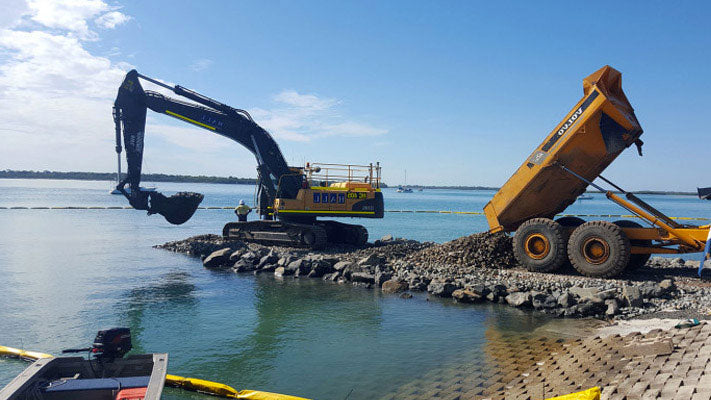
Turbidity barriers in place during shoreline construction activity. Barriers must be installed before active work begins.
Multiple layers of federal, state, and local regulation govern turbidity and sediment control at construction sites near water. Understanding which regulations apply to a project is the starting point for selecting and specifying turbidity barriers.
The Clean Water Act is the foundational federal statute governing water quality in the United States. Section 402 of the CWA establishes the NPDES permit program, which prohibits the discharge of pollutants — including sediment — into navigable waters without a permit. Sediment from construction sites qualifies as a regulated pollutant when it is discharged into waters covered by the CWA's jurisdiction.
CWA civil penalties can reach $25,000 per day per violation. Repeat or willful violations may trigger criminal liability. The cost of compliant turbidity barriers is a fraction of the potential penalty exposure.
The NPDES program requires construction sites that disturb one or more acres of land — or smaller sites that are part of a larger common plan of development — to obtain a permit and implement a Stormwater Pollution Prevention Plan (SWPPP). The SWPPP must identify Best Management Practices (BMPs) for sediment control, including turbidity barriers for sites with adjacent water bodies.
NPDES Phase II extended coverage to smaller sites. All Tough Guy turbidity barriers meet or exceed NPDES Phase II requirements.
Construction activities that involve the discharge of dredged or fill material into waters of the United States require a Section 404 permit from the Army Corps of Engineers. Permit conditions typically specify turbidity control requirements, monitoring protocols, and acceptable turbidity thresholds.
Work in, over, or under navigable waters of the United States requires a Section 10 permit. This includes bridge construction, pier installation, dredging, and similar activities in navigable channels. Section 10 permits typically include conditions governing sediment control and turbidity.

Turbid water from uncontrolled construction sediment. This condition violates Clean Water Act requirements and triggers NPDES enforcement.
State Departments of Transportation have their own specifications for turbidity barriers on publicly funded or state-permitted construction projects. These specs often prescribe not just that a turbidity barrier is required, but which DOT type must be used and what fabric specifications it must meet.
| State | Terminology | Classification |
|---|---|---|
| Most States | Turbidity Curtain | Type 1 / 2 / 3 |
| Connecticut | Turbidity Curtain | Flat / Light / Mid / Heavy |
| FL, MS, NJ | Floating Turbidity Barrier | Type 1 / 2 / 3 |
| Iowa, ND | Floating Silt Curtain | Still / Moving Water |
| Minnesota | Floating Silt Curtain / Silt Barrier | Type 1 / 2 / 3 |
| South Carolina | Floating Turbidity Barrier | Light / Medium / Heavy |
| Tennessee | Floating Turbidity Curtain | Type 1 / 2 / 3 |
| Nebraska | Turbidity Barrier | Type 1 / 2 / 3 |
The Tough Guy turbidity barriers available at Paramount Materials meet all known federal and state DOT specifications. Each product listing includes links to downloadable spec sheets, general design standards, barrier selection guides, and installation documentation for permit compliance purposes.
Turbidity barrier selection for construction projects is driven primarily by water conditions at the installation site:
| Site Conditions | Calm water, no current or waves |
| Typical Use | Pond restoration, canal work, still-water shoreline projects |
| Site Conditions | Moderate current (up to 1.5 knots), waves to 3' |
| Typical Use | River bridge work, harbor dredging, pile driving, port construction |
| Site Conditions | Strong current, tidal influence, demanding conditions |
| Typical Use | Bay and inter-coastal work, active navigation channels, major tidal crossings |
When site conditions are borderline between types, the cost-effective choice is to specify the higher type. The differential cost between Type 1 and Type 2 barriers is small compared to the cost of barrier failure, emergency replacement, and regulatory penalty. Many state DOT specifications also require an engineer's review for Type 2 installations at the upper current velocity range and all Type 3 installations.
|
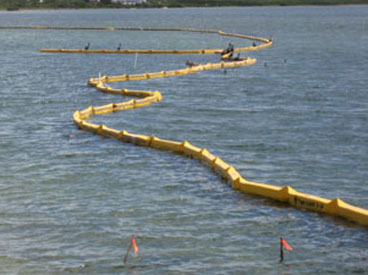
Type 1 DOT — Calm Water Construction SitesFor still-water environments: ponds, small lakes, canals, marshes. The 5' x 50' size ships within one business day for urgent project needs. All sizes available; other configurations require 5–7 business day lead time. Shop Type 1 Barriers → |
|
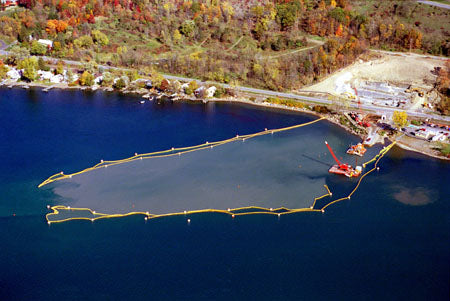
Type 2 DOT — The Standard for Active Waterway ConstructionRivers, harbors, ports, and tidal areas with currents up to 1.5 knots. The most widely specified barrier type for active waterway construction projects. Available in depths from 3' to 10' in standard 50-foot sections. Shop Type 2 Barriers → |

|
Type 3 DOT — Heavy-Duty for Demanding Construction SitesFor bays, inter-coastal waterways, and high-current construction zones. The 20% filter panel reduces hydraulic pressure while retaining sediment. Required by some state DOT specifications for specific waterway classifications regardless of actual current conditions. Shop Type 3 Barriers → |
For projects subject to NPDES permits, Army Corps permits, or state DOT specifications, documentation of turbidity barrier compliance is as important as the barrier itself. Paramount Materials provides the following documentation resources for all turbidity barrier products:
Paramount Materials provides a free online Turbidity Curtain Selector tool. Answer three questions about your site — water conditions, current velocity, and required depth — and get an instant recommendation for the correct barrier type.
Use the Turbidity Curtain Selector →Paramount Materials stocks Type 1, Type 2, and Type 3 DOT turbidity barriers — all Tough Guy brand, made in the USA, meeting or exceeding NPDES Phase II and all state DOT specifications. Free shipping on every order. Custom sizing available. Need a written quote? Submit a quote request online.
Shop All Turbidity Barriers →Turbidity barriers are required whenever construction activity occurs near a body of water and conventional land-based erosion controls cannot adequately contain sediment before it reaches the waterway. Federal requirements under the Clean Water Act and NPDES permit system trigger sediment control obligations for most construction sites disturbing one or more acres near waterways. State DOT specifications and local permits may impose additional or more specific turbidity barrier requirements.
Violations of Clean Water Act and NPDES requirements can result in civil penalties of up to $25,000 per day per violation. State environmental agencies may impose additional fines. Beyond financial penalties, projects can be shut down pending compliance, and contractors may be required to fund environmental remediation of affected waterways. The cost of a turbidity barrier is a small fraction of the potential penalty for non-compliance.
There is no universal distance threshold. Turbidity barrier requirements are triggered by the potential for construction activity to discharge sediment into a water body with a significant nexus to navigable waters under the Clean Water Act. Buffer zones vary by state and local regulation — some jurisdictions require sediment controls for any construction within 100 or 300 feet of a waterway. Always consult your state environmental agency and permit conditions for the specific project location.
Yes, turbidity barriers can be reused if they are properly cleaned, inspected, and stored after each use. Inspect all seams, flotation elements, grommets, and ballast chain for damage before redeployment. Fabric that has degraded from UV exposure, chemical contact, or mechanical abrasion should be replaced. Store cleaned barriers in a shaded, dry location to extend service life. Many contractors get multiple project deployments from a single barrier when properly maintained.
NPDES Phase I regulations (1990) initially applied to municipalities with populations over 100,000 and industrial facilities. Phase II (1999) expanded coverage to smaller municipalities and construction sites disturbing between one and five acres of land. All Tough Guy turbidity barriers sold by Paramount Materials meet or exceed NPDES Phase II requirements. For projects subject to stricter state or local permit conditions, always verify that the selected barrier type meets the specific permit requirements.
Paramount Materials provides downloadable spec sheets, installation guides, design standards, and barrier selection guides for all turbidity barrier products. These documents are suitable for inclusion in a Stormwater Pollution Prevention Plan (SWPPP), Army Corps Section 404 permit submittal, or state DOT project specification package. Use the Turbidity Curtain Selector tool to generate a site-specific product recommendation, then download the corresponding spec sheet for your permit documentation.