Questions?
(800) 748-5647
(800) 748-5647
(800) 748-5647
(800) 748-5647
A side-by-side comparison of Type 1, Type 2, and Type 3 DOT turbidity barriers — with specifications, decision criteria, and product recommendations from Paramount Materials.
In This Guide
Selecting the wrong turbidity barrier type for your site conditions is one of the most common and costly mistakes on waterway construction projects. A Type 1 curtain deployed in a tidal harbor will fail under load, releasing sediment, triggering regulatory violations, and requiring emergency replacement. A Type 3 curtain installed in a still pond is an unnecessary expense.
This guide breaks down every turbidity barrier type in detail — the technical specifications, the water conditions each is engineered for, and a clear decision framework for matching the right barrier to your site. It covers the Tough Guy DOT product line available at Paramount Materials, which is manufactured in the USA and meets all known federal and state DOT specifications.
A turbidity barrier is a floating sediment control barrier deployed in bodies of water to contain suspended silt, clay, and fine soil particles generated by construction, dredging, and excavation activity. "Turbidity" is the technical term for water cloudiness caused by suspended particulate matter — and elevated turbidity harms aquatic ecosystems by blocking sunlight, smothering bottom habitat, and clogging fish gills.
Federal law under the Clean Water Act and the NPDES permit system requires construction sites disturbing soil near water bodies to implement sediment controls. Turbidity barriers are the primary control method for in-water and near-water construction activities where conventional land-based erosion controls cannot adequately protect the waterway.
All DOT-compliant floating turbidity barriers share the same three-part structure, though the materials and reinforcements vary by type:
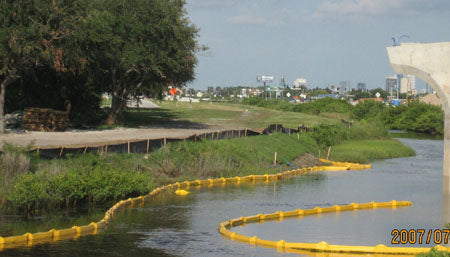
A turbidity barrier in place showing the flotation boom at the water surface and the impermeable fabric skirt extending below.
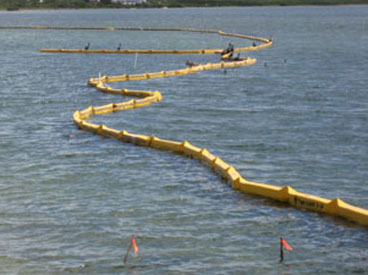
The Type 1 barrier is appropriate when the water body is calm and protected from wind-driven waves and tidal currents. This is the most widely specified barrier type for residential and small commercial construction projects near still water.
Key question to ask: Will the barrier be exposed to any wave action or current during the project? If yes, step up to Type 2.
View Type 1 Barriers →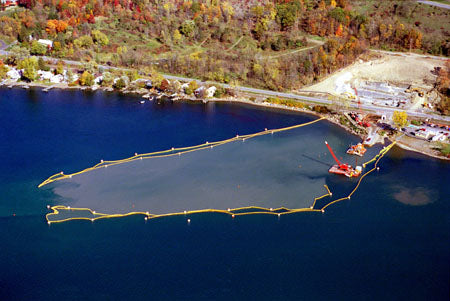
The Type 2 barrier is the workhorse of the DOT turbidity barrier line and covers the largest range of real-world waterway construction conditions. The added top load cable and aluminum stress plates distribute hydraulic load across the entire curtain, preventing the localized stress failures that occur with Type 1 barriers in moving water.
Most dredging, pile driving, bridge work, and demolition projects on rivers and harbors specify Type 2 as the minimum. Contact a qualified engineer for anchorage design when current velocities approach the upper limit of the Type 2 range.
View Type 2 Barriers →
Type 3 barriers solve a specific engineering problem: in high-current conditions, a fully impermeable skirt creates extreme hydraulic pressure that can distort, displace, or rupture the barrier. The 20% filter panel bleeds off this pressure while retaining sediment — extending the effective operational life of the barrier in demanding conditions and reducing the risk of failure during high-current or tidal events.
Type 3 is also required by some state DOT specifications regardless of actual current conditions when projects are located within certain waterway classifications.
View Type 3 Barriers →| Type 1 | Calm / still |
| Type 2 | Moderate current & wave |
| Type 3 | Heavy-duty / high current |
| Type 1 | Minimal |
| Type 2 | Up to 1.5 knots / 5 fps |
| Type 3 | High current / tidal |
| Type 1 | No |
| Type 2 | Yes — 5/16" galv. steel, 9,800 lb |
| Type 3 | Yes |
| Type 1 | No |
| Type 2 | Yes — aluminum |
| Type 3 | Yes |
| Type 1 | No |
| Type 2 | No |
| Type 3 | Yes — 20% polypropylene |
| Type 1 | 3' to 10' (custom to 100') |
| Type 2 | 3' to 10' (custom to 100') |
| Type 3 | 3' to 10' (custom to 100') |
| Type 1 | Yes |
| Type 2 | Yes |
| Type 3 | Yes |
Barrier selection comes down to a single overriding factor: water conditions at the installation site. The decision guide below covers the most common situations:
Calm pond, small lake, canal, or marsh. No wave action. No measurable current. Protected from wind-driven waves.
River, harbor, port, or tidal area. Current up to 1.5 knots. Waves up to 3'. Most active waterway projects.
Bay, active navigation channel, inter-coastal, or high tidal area. High current and wave conditions. State DOT may require Type 3 by specification.
Beyond type selection, barrier depth is the other critical sizing decision. The barrier must extend from the water surface to the bottom substrate along the full installation length. Using a barrier that is too shallow allows sediment to pass underneath the curtain — the most common cause of turbidity barrier failure on projects with variable water depth.
Standard depths run from 3 feet to 10 feet in 1-foot increments. For deeper water — dredging channels, river crossings, and similar applications — custom depths up to 100 feet are available with a lead time for fabrication.
The DOT Type 1/2/3 system described above refers exclusively to floating turbidity barriers. A separate product category — the staked turbidity barrier — serves a different purpose.
Staked turbidity barriers are land-based panels of impermeable vinyl-polyester fabric installed on stakes along the perimeter of a construction site. They are similar in function to silt fences but can be installed in as much as 18 inches of standing water. They are used when:
For most waterway construction projects, floating turbidity barriers are the primary sediment control; staked barriers may be used as supplemental perimeter controls on the upland portion of the site.
A floating turbidity barrier in place along a construction shoreline. Note the bright yellow flotation boom at the water surface.
Answer three questions about your site — water conditions, current velocity, and required depth — and get an instant product recommendation with a direct link to purchase.
Use the Turbidity Curtain Selector →All Tough Guy turbidity barriers are manufactured in the USA and meet or exceed NPDES Phase II and all known state DOT specifications. No off-brand or economy curtains — only commercial-grade product. Free shipping on every order.
Shop All Turbidity Barriers →A turbidity barrier is a floating or staked sediment control barrier used to contain turbid (sediment-laden) water near construction sites, dredging operations, and other activities in or adjacent to water bodies. Turbidity barriers prevent suspended sediment from spreading into open waterways, protecting aquatic ecosystems and keeping projects in compliance with Clean Water Act and NPDES requirements.
The choice depends on water conditions at your site. Type 1 is for calm, protected water with no waves or current — ponds, small lakes, and canals. Type 2 handles moderate conditions with currents up to 1.5 knots and waves to 3 feet — rivers, harbors, and ports. Type 3 is required for heavy-duty conditions near bays, active navigation channels, and inter-coastal waterways with strong tidal influence. When in doubt, use the Paramount Materials Turbidity Curtain Selector tool to get a site-specific recommendation.
Type 2 DOT turbidity barriers use 18 oz. nominal laminated vinyl/polyester fabric with a 9x9 1000x1300 denier polyester scrim construction. Grab tensile strength is 410x410 lb/in, tear strength 100x100 lb/in, and hydrostatic pressure resistance 600 psi. The curtain includes a 5/16-inch galvanized steel top load cable with 9,800 lb break strength, aluminum stress plates, and a galvanized chain ballast at the bottom.
Yes. Turbidity barriers are designed for use in both freshwater and saltwater environments. The EPS flotation elements provide 28.4 lb/ft buoyancy in saltwater versus 26.7 lb/ft in freshwater. The galvanized steel components are specified for marine use, and the vinyl-polyester fabric is chemically resistant to saltwater. For extended saltwater deployments, inspect hardware more frequently for corrosion.
Turbidity barrier, silt curtain, turbidity curtain, and silt containment curtain all refer to the same type of product: a floating barrier used to contain suspended sediment in bodies of water during construction. Different states and regulatory agencies use different terminology, but the products serve the same function. The Tough Guy line sold by Paramount Materials meets specifications under all of these names.