
Questions?
(800) 748-5647
(800) 748-5647
(800) 748-5647
(800) 748-5647
Everything you need to know about floating turbidity barriers — construction, DOT types, anchoring, and how to select the right barrier for your water conditions.
In This Guide
A floating turbidity barrier is the primary water-based sediment control tool for construction projects near rivers, lakes, bays, harbors, and inter-coastal waterways. Unlike land-based silt fences or sediment basins, a floating barrier goes into the water itself — creating a physical boundary between the disturbed construction zone and the open water body where sediment must not travel.
This guide explains how floating turbidity barriers are built, how they function, the three DOT type classifications and their differences, and what it takes to install and maintain a barrier for the duration of a project. It covers products from the Tough Guy line available at Paramount Materials — commercial-grade barriers manufactured in the USA and compliant with all known federal and state DOT specifications.
A floating turbidity barrier is a water-deployed sediment containment system consisting of three integrated components: a buoyant flotation boom that keeps the barrier at the water surface, an impermeable fabric skirt that extends downward through the water column, and a weighted ballast chain that keeps the skirt vertical and in contact with the substrate.
The barrier is deployed in sections — typically 50 feet long — that are connected to form a continuous run enclosing the construction area. Once deployed and anchored, it creates a sediment containment zone where disturbed silt and fine soil particles are trapped and allowed to settle rather than dispersing into the open water body.
Floating turbidity barriers are also referred to by several other names depending on state DOT terminology and industry convention: silt curtain, turbidity curtain, silt containment curtain, turbidity silt curtain, floating silt barrier, and floating turbidity curtain. All of these terms describe the same type of product.
The functional principle of a floating turbidity barrier is straightforward: it creates a physical barrier that suspended sediment cannot pass through. Here is what happens in practice:
The effectiveness of the barrier depends entirely on maintaining bottom contact along the full length of the skirt. Any gap at the substrate allows sediment-laden water to pass beneath the barrier, defeating the containment. This is why ballast chain weight and proper anchoring are critical to barrier performance.
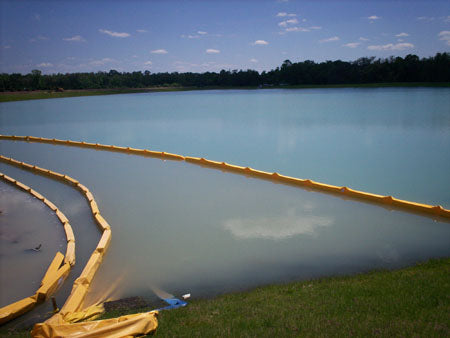
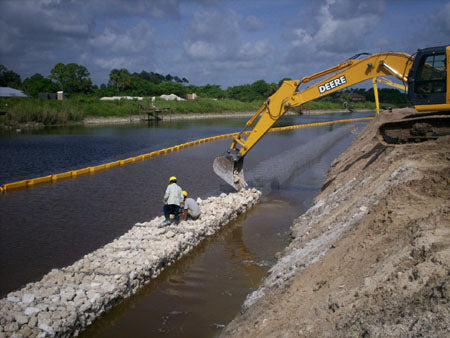
A floating turbidity barrier in active use, containing turbid water within the construction zone.
Commercial-grade floating turbidity barriers are manufactured from the following components:
All Tough Guy barriers are manufactured to the same cold-resistance standard: -40 degrees F/C. This makes them suitable for year-round deployment in cold-weather construction environments without fabric embrittlement or cracking.
The DOT classification system divides floating turbidity barriers into three types based on the water conditions they are engineered to withstand. Selecting the correct type for site conditions is the most important decision in the barrier procurement process.
|
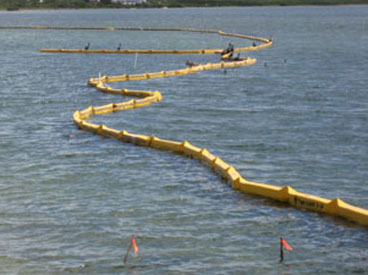
Type 1 DOT — Calm WaterDesigned for still, protected water with no wave action or measurable current. Appropriate for ponds, small lakes, canals, and marshes. The most economical option, and the right choice when site conditions are genuinely calm. Depths available: 3' to 10' | Sections: 50 ft standard Shop Type 1 → |
|
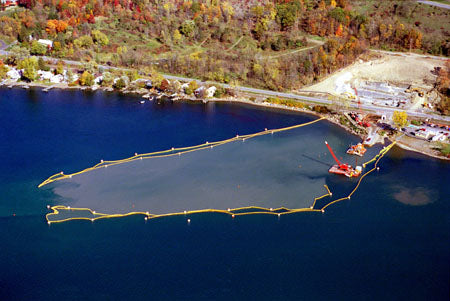
Type 2 DOT — Moderate ConditionsThe workhorse of the floating turbidity barrier line. Engineered for rivers, harbors, ports, and inter-coastal waterways with currents up to 1.5 knots and waves to 3 feet. Added top load cable and aluminum stress plates handle hydraulic loading that would distort or fail a Type 1 barrier. Depths available: 3' to 10' | Current: Up to 1.5 knots / 5 fps Shop Type 2 → |

|
Type 3 DOT — Heavy-DutyFor demanding conditions near bays, active navigation channels, and inter-coastal waterways with strong tidal influence. The 20% integrated polypropylene filter panel reduces hydraulic pressure on the skirt in high-current conditions while retaining sediment — solving the pressure-failure problem that occurs with fully impermeable skirts in high-flow environments. Depths available: 3' to 10' | Conditions: Strong current, high tidal, demanding sites Shop Type 3 → |
Floating Turbidity Barrier
|
Staked Turbidity Barrier
|
Most waterway construction projects use floating barriers as the primary sediment control in the water body, with staked barriers providing supplemental perimeter control at the upland edge of the site. The two barrier types are complementary, not interchangeable.
Floating turbidity barriers have two sizing dimensions, both of which must be correctly specified for the barrier to work:
Barriers are manufactured in 50-foot sections (100-foot custom sections are also available). Multiple sections are connected to form any required run length. The total length must be sufficient to enclose the active construction zone with adequate clearance — undersizing the run length creates gaps that allow sediment to escape around the ends of the barrier.
Barrier depth must match the water depth at the installation site. The bottom chain ballast must maintain contact with the substrate along the full length of the installation. Standard depths run from 3 feet to 10 feet in 1-foot increments. Custom depths up to 100 feet are available for dredging channels, deep river crossings, and other deep-water applications.
A floating turbidity barrier that is not anchored will drift out of position, potentially rupture, and fail to contain sediment. Anchoring requirements depend directly on site conditions:
|
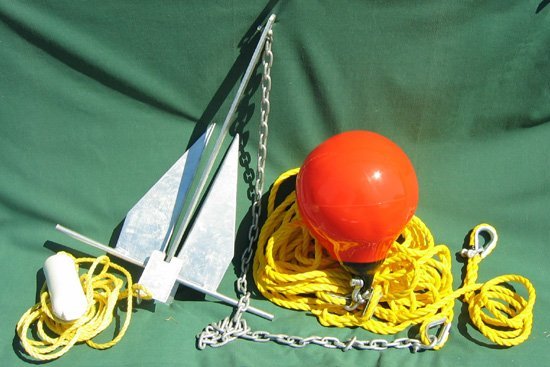
Anchor Kits for Floating Turbidity BarriersPre-assembled anchor kits include everything needed: anchor, chain, rope, thimbles, anchor buoy, and shackles. Two sizes are available:
Kits snap onto the cable loop at the barrier joint. The positioning buoy allows repositioning or removal during the project without diving or special equipment. Shop Anchor Kits → |
Custom anchor configurations — lighted navigation buoys, longer rope lengths, and specialty hardware — are also available for projects with specific maritime authority requirements or visibility needs.
Section connections must be secure before the barrier enters the water. Inspect all grommets, roping, and straps during land assembly.
A floating turbidity barrier requires regular inspection throughout the project to remain effective. The inspection checklist should cover:
Inspection frequency: daily for high-current, high-wind, and high-marine-traffic sites; weekly for calmer sites, plus after each significant storm event.
Answer three questions about your site conditions and get an instant recommendation for the correct turbidity barrier type and depth for your specific project.
Use the Turbidity Curtain Selector →Tough Guy brand — made in the USA, compliant with all federal and state DOT specifications including NPDES Phase II. Type 1, Type 2, and Type 3 in stock in all depths. Free shipping nationwide. Custom sizing available.
Shop Floating Turbidity Barriers →A floating turbidity barrier is a water-deployed sediment control barrier that uses a flotation boom at the top to stay on the water surface while an impermeable fabric skirt extends downward through the water column. A weighted chain at the bottom keeps the skirt vertical and in contact with the substrate. Floating turbidity barriers are used during waterway construction, dredging, and other activities to contain sediment and prevent it from spreading into open water.
A floating turbidity barrier is deployed in the water body and uses buoyancy to stay at the water surface. A staked turbidity barrier is installed on land along the water's edge using stakes driven into the ground, similar to a silt fence but capable of handling up to 18 inches of standing water. Floating barriers are appropriate for open water; staked barriers are used at the shoreline perimeter.
Yes. All floating turbidity barriers must be anchored to maintain their position. In calm water, stakes or concrete blocks may be sufficient. In moving water, tidal areas, and windy conditions, anchor kits with dedicated marine anchors, chain, and rope are required. Barriers installed in currents, tides, or wind must be anchored to stay in position — an unanchored barrier will drift and fail to contain sediment.
Floating turbidity barrier sizing has two dimensions: length and depth. Length is determined by the area to be enclosed — standard 50-foot sections are connected to form runs of any length. Depth must match the water depth at the installation site; the bottom chain ballast must contact the substrate along the full length of the barrier. Depths range from 3 to 10 feet in standard configurations, with custom depths to 100 feet available. Use the Paramount Materials Turbidity Curtain Selector to get a size recommendation for your specific site.
Lighted navigation buoys are attached to floating turbidity barriers to make them visible to marine traffic at night or in low-visibility conditions. Many local regulations require them when a turbidity barrier is installed in a navigable waterway or channel. Always check local maritime and waterway authority requirements before installing a floating turbidity barrier in a navigable body of water.